Hard Water Damage in Irvine: 9 Things It Quietly Does to Your Home
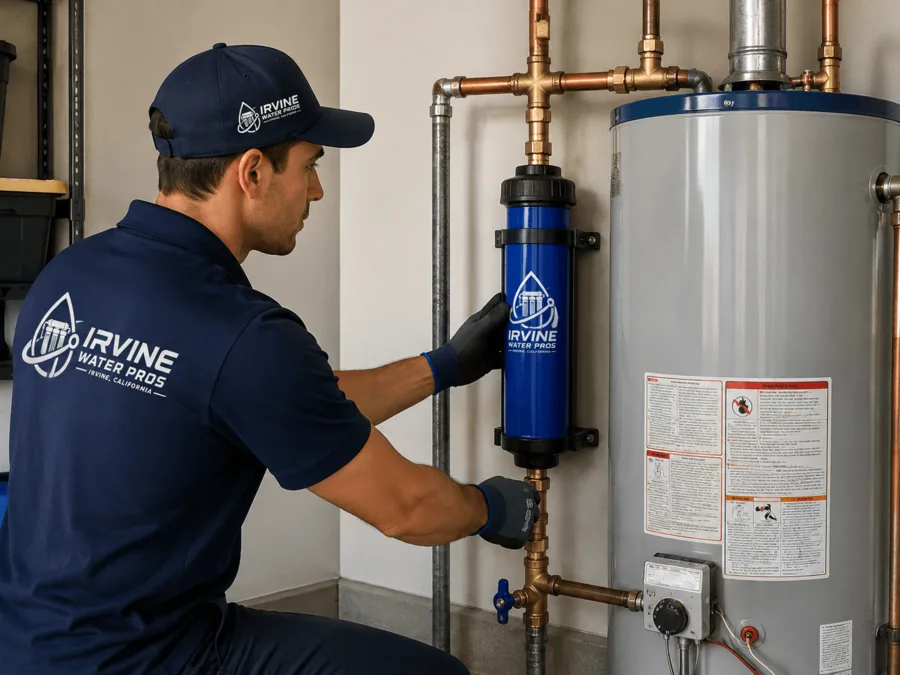
Hard water damage in Irvine is cumulative, not dramatic. Nothing floods and nothing fails overnight; the minerals dissolved in your tap water simply leave a little of themselves behind every time the water is heated, evaporates, or meets soap. A decade of that adds up to a water heater running hotter for the same shower, a dishwasher that never quite finishes the job, and a glass shower door no cleaner will rescue.
Irvine's supply is hard enough for this to matter. The Irvine Ranch Water District blends roughly 65% local groundwater from the Orange County Groundwater Basin with about 35% imported supply, and the district treats 10 grains per gallon or more as hard water. Imported Colorado River and Northern California water runs harder than the local wells, so the mineral load reaching your house shifts with the season and with where in the service area you live. Here are nine places that load quietly shows up.
1. Hard water damage starts inside the water heater
Heating hard water is what triggers the deposit. According to the U.S. Geological Survey, "when hard water is heated, such as in a home water heater, solid deposits of calcium carbonate can form," and that scale "can reduce the life of equipment, raise the costs of heating the water, lower the efficiency of electric water heaters, and clog pipes." The mechanism is unintuitive: calcium carbonate is less soluble hot than cold, so the hottest surface in the tank, the burner plate or the element, is where it plates out first. A layer of mineral between the heat source and the water is insulation you did not ask for. The Department of Energy puts water heating at about 18% of a home's energy use and calls it the second largest energy expense in a typical home, so a heater working through scale is working against a bill you were already paying.
2. A tankless unit meets that scale sooner than a tank does
Tankless heaters concentrate the same problem into a much smaller space. Instead of a forty or fifty gallon tank with room to spare, the water runs through a narrow heat exchanger built to transfer heat fast, which is exactly the condition that drops calcium carbonate out of solution. A tank can carry a layer of sediment on the bottom for years and still deliver hot water. A scaled exchanger starts throttling flow and swinging temperature much earlier, and the symptom homeowners describe is a shower that cycles warm and cool for no obvious reason. Manufacturer maintenance instructions for tankless units call for periodic descaling, and that interval tightens as hardness rises.
3. The white spots on your glassware are minerals, not weak detergent
Spots are what hard water leaves behind when it evaporates off a surface instead of running off it. The Irvine Ranch Water District says it plainly: "while the hardness of the water does not affect its safety, the higher mineral content can cause white spots on glasses in the dishwasher." Rinse aid works by breaking surface tension so droplets sheet off before they can dry in place, which is why spotting gets noticeably worse the week the dispenser runs empty. Repeated cycles stop producing discrete dots and start producing a dull overall film, and at that point the glass is carrying a mineral deposit that dish detergent was never formulated to remove.
4. Your washing machine collects detergent curds instead of lather
Hard water minerals react with soap before the soap can act on your laundry. Penn State Extension describes the result directly: hard water leaves "soap films on skin, and detergent curds in the washing machine." Those curds are the same soap scum that rings a bathtub, deposited instead in the drum, the hoses and the fabric itself. Clothes washed in hard water hold that residue, which is why towels lose their absorbency and whites drift grey in a way more bleach does not fix. Modern detergents carry sequestering agents that tie up some of the calcium, but they are consumed doing it, leaving less of the formula working on actual dirt.
5. Shower heads and aerators clog from the inside out
Every shower head and faucet aerator is a set of small orifices where water sits and evaporates at the exit. Minerals accumulate at exactly those edges, and the spray pattern degrades well before the volume does: one jet aiming sideways, then two, then a head that fans unevenly no matter how you turn it. Aerators fail in a different way. The screen catches flakes of scale that have broken loose upstream, so one kitchen tap slows to a trickle while the rest of the house seems normal. Both are the cheapest hard water symptoms to fix and the easiest to misdiagnose as a plumbing fault.
6. Soap scum bonds to shower glass, and scrubbing is what leaves the haze
Shower glass fails in two stages, and only the second one is permanent. First, calcium and soap combine into a film that grips the microscopically porous surface of the glass. Second, the abrasive cleaners and scouring pads used to attack that film leave scratches of their own, and those scratches hold the next round of deposit more tightly than clean glass ever could. The same sequence plays out on drinking glasses run through a dishwasher for years. Once a shower door has gone cloudy it stays cloudy, because the problem is no longer a deposit sitting on the surface. It is the surface.
7. You buy more soap and get less cleaning out of it
Soap in hard water is spent neutralizing minerals before it can lift soil. The U.S. Geological Survey puts the chemistry plainly: "in hard water, soap reacts with the calcium (which is relatively high in hard water) to form 'soap scum'." Penn State Extension draws the practical conclusion, noting that soap film and detergent curds in bathtubs and appliances "indicate that you are not getting the maximum cleaning action." The normal household response is to use more product, which raises the residue faster than it raises the cleaning. This one never shows up as a repair bill. It shows up as a shopping habit nobody questions.
8. Skin and hair feel coated, and that film is real
The slick-then-squeaky feeling after a shower in hard water is soap scum deposited on you. The same reaction that leaves a ring in the tub happens on skin and hair, leaving a residue the next wash has to work through before it can do anything else. Worth stating clearly, because this item attracts the most exaggeration: it is a comfort complaint, not a health one. Penn State Extension notes that from a health standpoint the calcium and magnesium in hard water "have no adverse effects and are, in fact, essential daily nutrients." What the minerals change is how soaps and shampoos perform on you, not whether the water is safe to use.
9. Hard water damage reaches your pipes last, and slowly
Scale inside supply lines is the slowest item on this list and the hardest to see. The USGS describes a gradual process in which "long-term movement of hard water through a pipe can result in what is called scale buildup," so that "water pipes can gradually close up resulting in less water movement through the pipe and a lowering of water pressure." Hot lines scale faster than cold ones, because heat is what drives the deposit, so the first real complaint is usually weak hot water at the fixture furthest from the heater. The change happens across years rather than months, which is why most households quietly adjust their expectations instead of noticing a problem.
Which of these nine shows up in your house first
Where the damage lands first depends on how your house uses hot water. A household running the dishwasher nightly meets spotting and film long before anything happens to the plumbing; a house with a tankless unit and long showers reaches the heat exchanger first; a rental with low hot-water use may show nothing but a cloudy shower door for a decade. The useful move is to rank these nine by what you already recognize. If three or four of them read as a description of your own kitchen rather than a general article, hardness is doing measurable work in your home, and the next step is a number rather than another cleaner. Irvine hardness also varies by season and by position in the district, so a figure on one report is a starting point, not a verdict.
When the pattern points squarely at the water heater, that is the piece worth handling first, and scale prevention and water heater protection is the job Irvine Water Pros takes on for exactly this reason. On-site water testing turns a symptom list into a figure you can act on.
Sources: Irvine Ranch Water District — Water Quality Report · U.S. Geological Survey — Hardness of Water · Penn State Extension — Water Softening · U.S. Department of Energy — Water Heating
Want cleaner, safer water in your Irvine home? Call now for a free quote.
Get a Free QuoteHave a Question About Your Water?
The fastest way to real answers is an on-site water test. We'll measure it, explain it, and tell you honestly what — if anything — you need.
Get a Free QuoteCall (949) 687-3362 — Irvine's licensed, test-first water team.