How to Test Your Tap Water in Irvine Before You Buy Any Filter
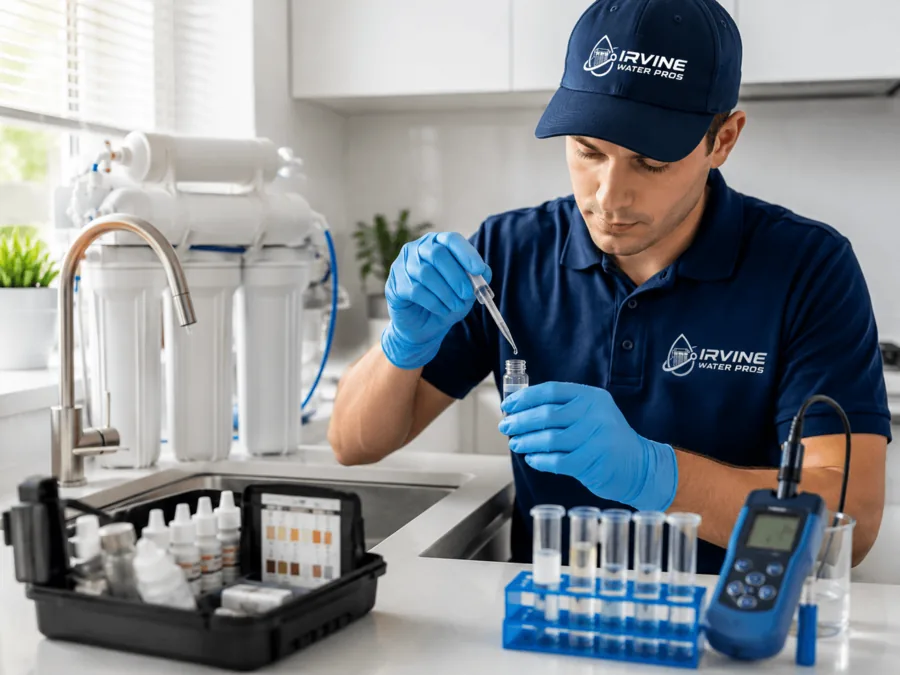
About 65% of the water Irvine Ranch Water District delivers is local groundwater pumped from the Orange County Groundwater Basin, and the other 35% arrives imported from the Colorado River and Northern California. That blend is why two Irvine households a few miles apart can have noticeably different water, and it is also why guessing your way to a filter rarely works out. Before you price a softener or an under-sink system, spend an afternoon finding out what is actually coming out of your tap.
Testing your tap water is a three-part job: read what your utility already publishes, measure the one thing you can reliably measure yourself, and pay a certified lab only when the question warrants it. Here is how to do each part, in order, and what each one can and cannot tell you.
Key takeaways
- Your annual water quality report is free, already written, and legally required: EPA rules put it in customers' hands by July 1 each year.
- A utility report describes water leaving the treatment and distribution system, not water that has passed through your own building's pipes.
- A home hardness test measures dissolved calcium and magnesium. It identifies no specific contaminant, and says nothing about lead, bacteria or nitrate.
- Irvine Ranch Water District treats its water with chloramine rather than free chlorine, which changes which filter media will actually remove the taste.
- Hardness is a nuisance property rather than a health concern, so a high reading is a budget decision instead of an emergency.
- A state-certified laboratory is the right call for lead, bacteria, nitrate, and anything a doctor or a real-estate transaction will ask about.
Step 1: Read the water quality report your utility already sends you
Start with the Consumer Confidence Report, the annual drinking water quality report every community water system has to publish. The EPA requires it to name the lake, river or aquifer the water comes from, list the regulated contaminants detected in local drinking water, describe health effects where a standard was violated, and reach customers by July 1 each year. It costs nothing, it is already written, and it is the densest source of information about your supply you will ever be handed for free.
For most Irvine addresses that report comes from Irvine Ranch Water District, and the district's own summary is worth reading alongside it: roughly 65% local groundwater from the Orange County Groundwater Basin, 35% imported through the Metropolitan Water District, chloramine used to hold a disinfectant residual in the distribution system, and laboratory work screening more than 100 organic compounds down to less than one part per trillion. Pay attention to the chloramine line in particular. Chloramine is more stable than free chlorine and needs longer carbon contact time to strip out, which is why a cheap faucet-mounted filter so often disappoints here.
Step 2: Understand what that report cannot tell you
A utility report describes the water the system produces and distributes, not the water at your kitchen faucet. Everything between the water main and your glass sits outside the utility's sampling program: the service line, the building's own pipes, solder joints, a water heater, an aging softener a previous owner installed and nobody has serviced since.
Two local gaps matter most. IRWD notes that hardness varies by location and season as the ratio of groundwater to imported supply shifts, so a single reading is a snapshot rather than a constant. And lead, when it turns up in a home, generally comes from household plumbing and fixtures rather than the source water, which means the report's lead figures say very little about a 1970s house with original brass fittings. If you rent, live in a condo with shared risers, or have a long branch line feeding a back bathroom, that gap widens further.
Step 3: Measure your own hardness, and know the limits of the strip
A home hardness test measures dissolved calcium and magnesium, reported either as milligrams per liter of calcium carbonate or as grains per gallon. The USGS classifies 0 to 60 mg/L as soft, 61 to 120 as moderately hard, 121 to 180 as hard and above 180 as very hard, and is explicit that hardness is a nuisance rather than a health concern. IRWD works in grains and treats 10 grains per gallon or more as hard; it describes its own well water as moderately hard, while imported supply tends to arrive at the higher end.
Sample properly or the number means nothing. Draw cold water from a tap that is not downstream of an existing filter or softener, let it run for thirty seconds so you are reading the main supply rather than water that has been sitting in the line, and write down which fixture you used and when. Then be honest about the ceiling on what you have learned. A hardness strip tells you about scale and soap performance. It tells you nothing about bacteria, nitrate, lead, or the disinfection byproducts a laboratory would look for.
Step 4: Decide which contaminants your test should actually cover
Build the list from your own house rather than from a product catalogue. A sensible baseline for an Irvine home on district water is hardness, total dissolved solids, chloramine residual and pH. Those four numbers between them explain most complaints about scale, spotting, cloudy ice and flat-tasting coffee, and they are all readings a technician can take at your tap in a single visit.
Then add whatever your particular situation argues for. Pre-1986 plumbing or original brass fixtures puts lead and copper on the list. Rust rings in the toilet or a sulfur smell point at iron, manganese and hydrogen sulfide instead. A property on a private well rather than district service changes the list entirely: the EPA recommends testing a private well every year for total coliform bacteria, nitrates, total dissolved solids and pH, then adding parameters based on what sits nearby, such as agriculture or industrial land. If your water quality report flags something you have never heard of, look it up before you shop rather than after.
Step 5: Know when a certified lab test is worth paying for
A certified laboratory earns its fee whenever the answer has to hold up to somebody else. EPA guidance for homeowners is blunt about it, instructing well owners to only use laboratories that are certified to do drinking water testing, because certification is what ties a result to a defined analytical method, a documented detection limit and a chain of custody. A test strip has none of that behind it.
In practice, pay for a lab when you are testing for lead, bacteria, nitrate or anything else carrying a health standard; when a purchase, a sale or a lease dispute depends on the number; when someone in the household is pregnant, immunocompromised or an infant on formula; or when you are about to commit to a whole-house system large enough that being wrong is expensive. For the ordinary job of sizing a softener or choosing a drinking water filter, an on-site reading of hardness, chloramine and TDS is usually enough to work from.
Step 6: Match each result to the system that actually fixes it
Each reading points at a different piece of equipment, which is the entire reason the order matters. High hardness is an argument for a softener or a salt-free conditioner. A chlorinous or swimming-pool taste is a carbon problem, which is why carbon filtration is the usual answer for district water here rather than a sediment cartridge. High dissolved solids, or a flat mineral taste in drinking water specifically, points toward reverse osmosis or an under-sink filter serving one tap instead of treating the whole house.
Stains and odors run the other way. Orange rings and a rotten-egg smell indicate iron and sulfur, not hardness, and a softener on its own will not resolve them. Bacteria on a private well is the one result that genuinely argues for UV disinfection. Read your numbers first and the shortlist more or less writes itself. Shop first and you end up owning a system that treats a problem your water does not have.
What to do once you have your numbers
The sequence is what saves money here. The report is free and tells you what is in the supply. The hardness test is cheap and tells you how that supply is behaving at your address. The laboratory bill is only worth paying when a health question or a contract is riding on the answer. Worked in that order, a vague worry about water quality usually narrows down to one or two specific readings, and one or two readings are enough to choose equipment with. It also tends to shorten the shopping list: plenty of Irvine homes turn out to need scale control and better-tasting drinking water, and nothing else at all.
If the report raises a question a strip cannot settle, that is the point where having someone measure it at the fixture pays for itself. Irvine Water Pros handles on-site water testing and analysis across Irvine and the neighboring Orange County cities, and will walk through what each number means before any equipment enters the conversation.
Sources: U.S. EPA, Consumer Confidence Reports; Irvine Ranch Water District, Water Quality Report; USGS Water Science School, Hardness of Water; U.S. EPA, Protect Your Home's Water.
Want to know exactly what is in your Irvine tap water? Book an on-site test and get the numbers first.
Get a Free QuoteHave a Question About Your Water?
The fastest way to real answers is an on-site water test. We'll measure it, explain it, and tell you honestly what — if anything — you need.
Get a Free QuoteCall (949) 687-3362 — Irvine's licensed, test-first water team.