UV Water Purification: When Does Your Irvine Home Actually Need It?
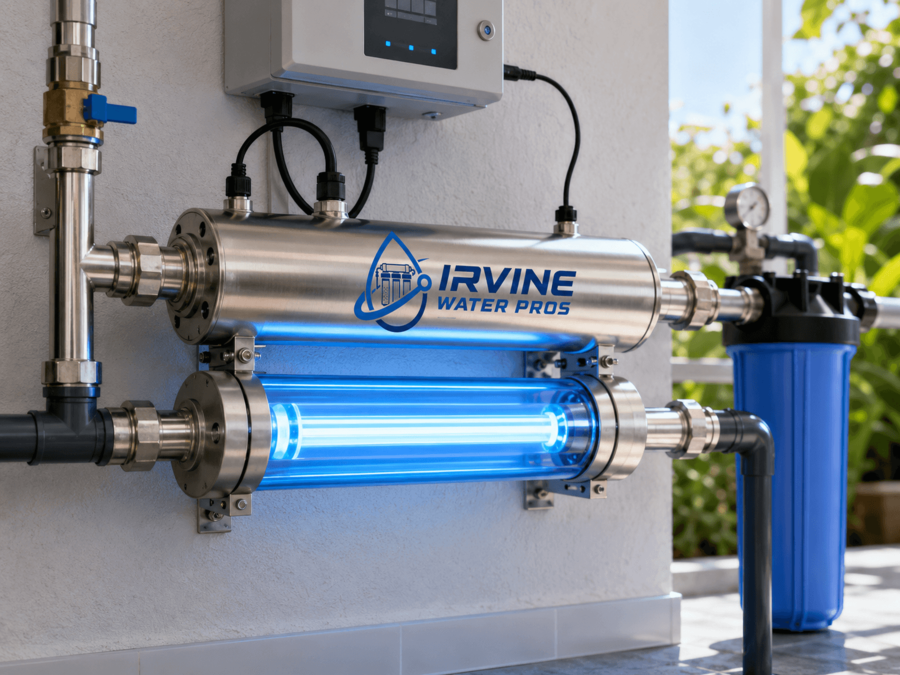
Water utilities and hospitals have used ultraviolet light to disinfect water for decades, and the same technology now fits under a kitchen sink or beside a well pump. But UV water purification is widely misunderstood: it is excellent at one job and does nothing for several others. So when does an Irvine home actually need it? Here is how UV works, what it will and will not do, and who benefits most.
How does UV water purification work?
UV water purification uses ultraviolet light to inactivate microorganisms so they can no longer reproduce or make you sick. Water flows through a chamber past a UV lamp, and the light disrupts the DNA of bacteria and viruses. The CDC notes that water treatment plants themselves can use UV light to disinfect water. Crucially, UV adds nothing to your water: no chlorine, no taste, and no disinfection byproducts.
What UV removes, and what it does not.
UV disinfects, but it does not filter. It is highly effective against living organisms such as bacteria and viruses, yet it does nothing for chemicals, metals, hardness, sediment, or taste and odor. The CDC's guidance on home filters makes the point that different methods target different problems, so you match the tool to what your water actually contains. That is why UV is almost always paired with filtration rather than used on its own.
- Inactivates: bacteria, viruses, and other living microorganisms
- Does not remove: chlorine or chloramine, lead and other metals, nitrate, hardness, sediment, or bad taste and odor
Why UV needs clear water and a pre-filter.
UV only works if the light can actually reach the microorganisms, so cloudy or sediment-heavy water shields them and lets them slip through. For that reason a sediment pre-filter is installed ahead of any UV system. The CDC similarly notes that some systems require pre-treating water before filtering to protect the equipment and make sure it works properly. Clear water in means reliable disinfection out.
Wondering whether UV is right for your Irvine home or well? A free on-site water test shows whether disinfection is worth adding at all.
Get a Free Water TestDoes city water in Irvine need UV?
For most homes on Irvine's municipal supply, UV is optional rather than necessary. City water already arrives disinfected, and the CDC explains that utilities leave a low level of residual disinfectant in the water so it keeps killing germs as it travels through the pipes to your tap. UV, by contrast, only disinfects at the point where it is installed and leaves no residual protection downstream. On already-treated city water, UV is best understood as an extra layer of assurance, not a requirement.
Who actually benefits from UV?
UV earns its place where water is not already disinfected, or where an added safeguard is genuinely useful:
- Homes on a private well, where there is no municipal disinfection at all
- Households with someone who has a weakened immune system, who the CDC notes are more likely to get sick from germs in water
- Anyone who wants a chemical-free final stage on a whole-house system
UV is the right answer to exactly one question: is anything alive in my water? For everything else, from chlorine taste to hardness, it is the wrong tool, and pairing matters more than the lamp itself.
Common questions about UV water purification
Does UV purification remove chlorine or hardness?
No. UV only inactivates living organisms; it does nothing for chlorine, hardness, metals, or sediment. To handle those, pair UV with carbon filtration for taste and chlorine or a softener for hardness.
Do I need UV if I am on Irvine city water?
Usually not. Municipal water is already disinfected and carries a residual disinfectant through the pipes, so UV is mainly valuable for private wells or as an extra layer of assurance rather than a requirement.
How often does a UV system need maintenance?
The UV lamp gradually loses intensity over time and is typically replaced about once a year per the manufacturer, while the sediment pre-filter is changed on its own schedule to keep the water clear enough for the light to work.
Sources: U.S. Centers for Disease Control and Prevention, How Water Treatment Works and About Choosing Home Water Filters (cdc.gov).
Have a Question About Your Water?
The fastest way to real answers is an on-site water test. We'll measure it, explain it, and tell you honestly what — if anything — you need.
Get a Free QuoteCall (949) 687-3362 — Irvine's licensed, test-first water team.